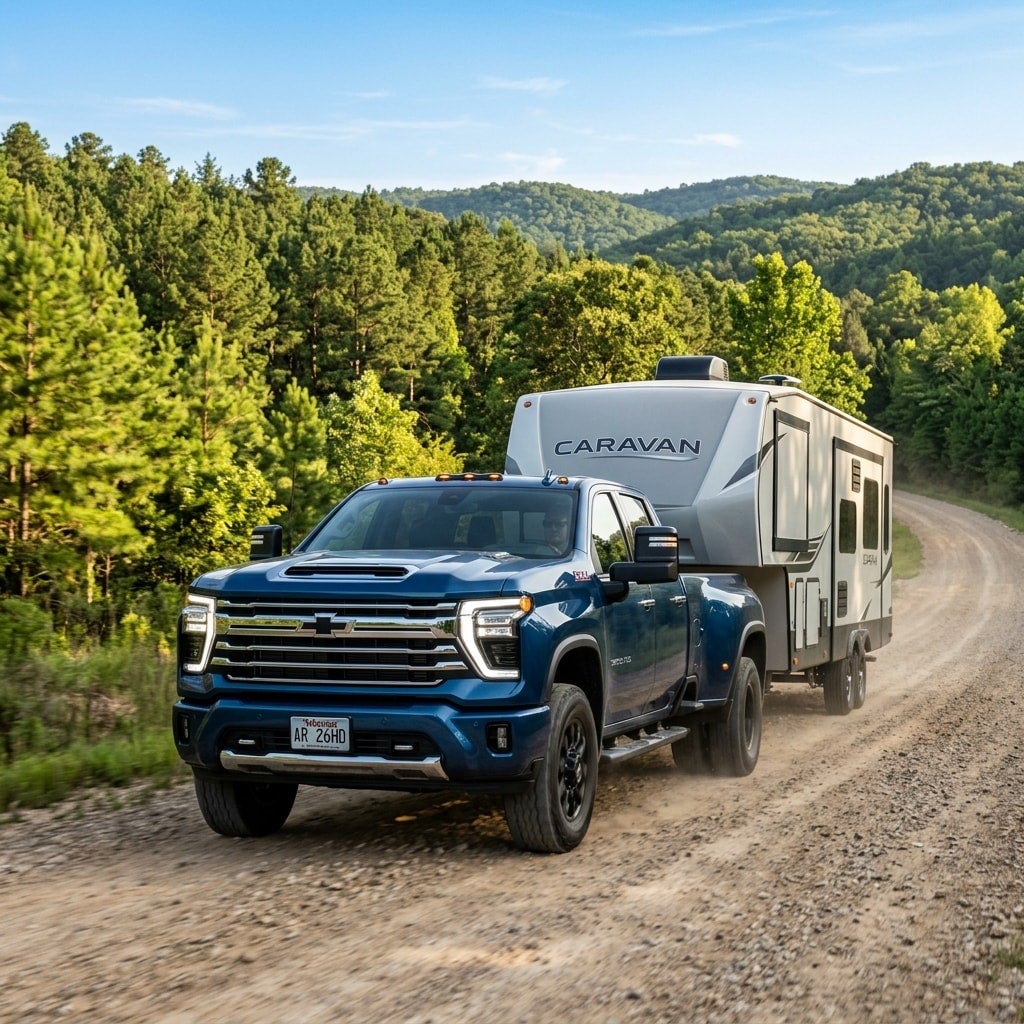





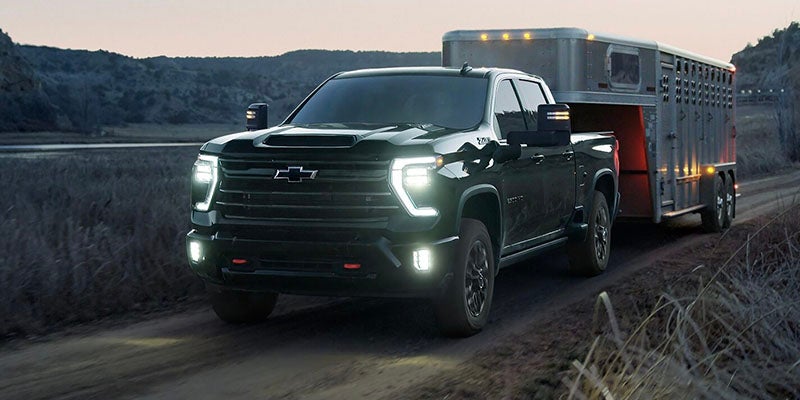
A loaded three-horse gooseneck rig sits comfortably inside what a 2026 Chevrolet Silverado 2500HD will pull, and for most people hauling around Hot Springs the deciding question is not whether the truck can do it but which cab, bed and engine you want under you for the trip. A Crew Cab 2500HD is rated to 18,500 pounds on a conventional hitch when properly equipped, and a Duramax truck with the Max Trailering Package and a long bed reaches 22,050 pounds on a gooseneck or fifth-wheel hitch.
We sell trucks to people who haul livestock for a living and to people who take two horses to Oaklawn Racing Casino Resort a few times a season, and those are different trucks. This post walks the haul the way you actually do it — the hitch on the ball, the rig behind you, the road between your barn and the paddock — and lands on which configuration fits which version of that.
- A properly equipped Crew Cab 2026 Silverado 2500HD tows up to 18,500 pounds on a conventional hitch.
- Properly equipped with the 6.6L Duramax and the Max Trailering Package, the lineup maximum is 20,000 pounds conventional and 22,050 pounds on a gooseneck or fifth-wheel hitch.
- A gas Crew Cab carries 3,426 pounds of payload; the lineup maximum is 3,926 pounds on a Work Truck Regular Cab long-bed rear-drive with the gas V8.
- An integrated trailer brake controller is standard on all six trims, including the entry Work Truck.
- The 6.6L Duramax turbo-diesel makes 470 horsepower and 975 lb-ft and pairs with an Allison 10-speed automatic.
What a Horse Trailer Actually Asks of a Truck
Livestock is live weight. It shifts when you brake, it leans into a curve, and it does not settle the way a boat or a stack of lumber does. That puts the demand on three numbers rather than one, and towing capacity is only the first of them.
The second is payload, because a gooseneck hitch puts the trailer's pin weight straight down onto your rear axle, and that weight comes out of the same budget as passengers, tack, feed and anything in the bed. A gas Crew Cab starts with 3,426 pounds of payload to spend. The lineup maximum of 3,926 pounds belongs to a Work Truck Regular Cab long-bed rear-drive with the gas V8, which is the lightest truck in the range and therefore the one with the most left over.
The third is the hitch itself. A bumper-pull two-horse trailer rides on a conventional receiver; a three-horse or four-horse with living quarters almost always rides on a gooseneck, and that is a different rating and a different bed. The full ladder by cab, bed and engine is laid out on our Silverado 2500HD towing and payload page, and the specifications page carries the bed lengths and weights those ratings depend on.
The Three Configurations Worth Looking At
Every 2026 Silverado 2500HD can be ordered with either engine, on any trim, so this is a question about cab, bed and powertrain rather than about badge. Three builds cover almost everyone who pulls a horse trailer in Garland County.
| Build | What it suits | Headline figure |
|---|---|---|
| Gas V8 Crew Cab, standard bed | Two horses on a bumper-pull, a few trips a season, family in the back seat | 401 hp, 464 lb-ft; 3,426 lbs payload |
| Gas V8 Crew Cab, long bed | A gooseneck three-horse, weekend distances, room for the hitch in the bed | Up to 18,500 lbs conventional, properly equipped |
| Duramax Crew Cab, long bed, Max Trailering | Living-quarters trailers, sustained highway hauls, hauling for a living | 470 hp, 975 lb-ft; 22,050 lbs gooseneck |
The gas 6.6L V8 makes 401 horsepower and 464 lb-ft and is the standard engine across the range. The available 6.6L Duramax turbo-diesel makes 470 horsepower and 975 lb-ft and runs through an Allison 10-speed automatic. The difference you feel with a trailer behind you is torque low in the rev range and how little the truck has to work to hold a speed, which is the whole subject of our engines and performance page. Which trim you wrap around that engine is a separate decision, and the trims and pricing page prices every rung from the $45,900 Work Truck up.
The Roads You Will Actually Be On
The haul from a barn outside Hot Springs to the Oaklawn paddock is short, and short hauls test a truck in ways a spec sheet does not show: backing a gooseneck into a tight lot, holding a lane on a crowned two-lane, stopping a live load at a light you did not expect to catch.
Longer runs change the calculus. Coming up from Arkadelphia or across from Malvern puts you on Interstate 30 with a loaded rig at highway speed, and that stretch is where the diesel's torque and the exhaust brake stop being a line item and start being the reason you arrive unbothered. An integrated trailer brake controller is standard on every trim, so the entry Work Truck leaves the lot ready to wire a trailer rather than needing a shop visit first.
Cab choice matters more than people expect on these trips. A Crew Cab seats six, which covers the riders and whoever came to help load, and it is the cab almost everyone actually orders. A Regular Cab seats three and returns the most payload, which is the trade that makes it the lineup's payload champion.
Which One Fits Your Season
Two horses, a bumper-pull, a handful of trips a year. The gas Crew Cab is the right truck. It has the capability the rig asks for, the back seat gets used, and every dollar you do not spend on the diesel is available for the trim you actually want to sit in.
A gooseneck three-horse and regular weekends. Go long bed. The bed length is what makes the gooseneck hitch work properly, and it is the harder thing to change later. Either engine will pull it; pick the engine on how far you go, not on the trailer.
Living quarters, or hauling as work. Duramax, long bed, Max Trailering Package. That is the build behind the 20,000-pound conventional and 22,050-pound gooseneck figures, and it is the one that treats a long haul as routine.
If you are still weighing whether you need a 2500HD at all, the Silverado 1500 and 2500HD comparison covers where the line sits, and the 2500HD and 3500HD comparison covers what the next step up buys. Service intervals and coverage for either engine are on the maintenance and reliability page, and if your season also involves a rough track to a back pasture, the ZR2 page covers the off-road hardware.
Come Weigh It Against Your Own Rig
Bring the trailer. Bring the weight slip if you have one. We will put your numbers against the cab, bed and engine combinations and tell you which build fits, and you can drive it with the hitch on before you decide. Start with the Silverado 2500HD inventory, schedule a test drive, or start financing when you have picked the truck. The full research set lives on the 2026 Silverado 2500HD guide, and quick answers are on the FAQs page. Every configuration and price is on the Silverado 2500HD overview.
Horse Trailer and Silverado 2500HD FAQs
Can a Silverado 2500HD pull a loaded three-horse gooseneck?
Yes. Properly equipped with the 6.6L Duramax and the Max Trailering Package, the 2500HD is rated to 22,050 pounds on a gooseneck or fifth-wheel hitch, which a loaded three-horse rig sits well inside. Weigh your own trailer loaded, because water, feed and tack move the number more than people expect.
Do I need the diesel, or is the gas V8 enough?
Not for a bumper-pull two-horse trailer. The 6.6L gas V8 makes 401 horsepower and 464 lb-ft and is rated to 16,000 pounds on a conventional hitch when properly equipped. The Duramax earns its place on sustained highway hauls and heavier gooseneck rigs.
How much payload do I have for pin weight and tack?
A gas Crew Cab starts with 3,426 pounds. The lineup maximum is 3,926 pounds on a Work Truck Regular Cab long-bed rear-drive with the gas V8. Passengers, tack, feed and gooseneck pin weight all draw on the same figure.
What comes standard on the entry Work Truck?
An integrated trailer brake controller is standard on all six trims, so the $45,900 Work Truck is wired for a trailer as delivered rather than needing a shop visit first.
What does servicing a Duramax involve compared with the gas V8?
Both follow the same first scheduled visit at 12 months or 12,000 miles. The Duramax carries five years or 100,000 miles of diesel powertrain coverage, and the intervals and coverage for both engines are set out on the maintenance and reliability page.